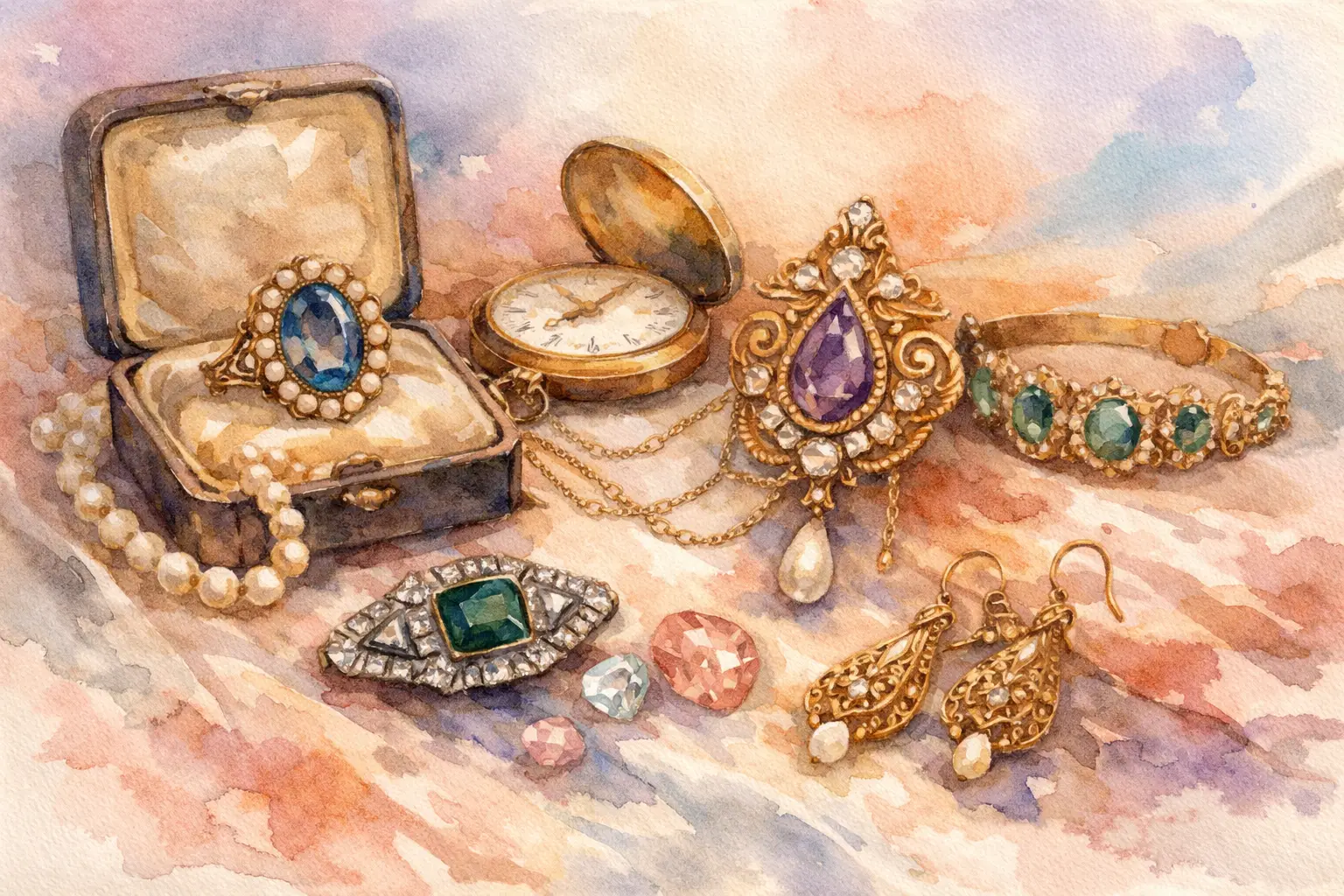
The best antique jewelry rarely appears where everyone is looking. By the time a strong Georgian ring, an intact Belle Epoque necklace, or a signed Art Deco brooch reaches the major platforms, the advantage has usually shifted to whoever saw it earlier. That is the real issue behind how to source antique jewellery - not just where to look, but how to identify emerging supply before it becomes obvious.
For serious buyers, sourcing is an intelligence problem. Antique jewelry lives in a fragmented market shaped by regional auction houses, estate dispersals, under-described dealer stock, private sales, and listings that never receive broad search visibility. Taste matters, of course. So does budget. But timing, attribution, and access matter more than most buyers admit.
If your process begins and ends with mainstream auction calendars and a few well-known dealers, you are not sourcing the market. You are reviewing the visible layer of it. That may still produce purchases, but it is a reactive method, and reactive methods are expensive.
The stronger approach is to define your acquisition profile with precision, then monitor beyond the obvious. "Antique jewelry" is too broad to be useful. Edwardian diamond cluster rings under 3 carats, natural pearl earrings with original fittings, late Victorian serpent motifs, signed 1920s Cartier clips, Iberian devotional jewelry, or Georgian memorial pieces with documented provenance - those are searchable targets. Precision sharpens discovery.
This is also where many collectors lose momentum. They know what they like aesthetically, but they have not translated taste into a sourcing brief. A proper brief includes period, maker if relevant, material priorities, acceptable condition issues, preferred geography, certification requirements, and price ceiling. Without that framework, opportunities pass unnoticed because the listing language is inconsistent or incomplete.
Most buyers ask where to source. The better question is what, exactly, you are trying to source.
A collector building a serious antique jewelry position should separate decorative buying from strategic buying. Decorative buying is driven by visual appeal and immediate desire. Strategic buying adds scarcity, historical relevance, workmanship, survivability, and resale resilience. The overlap can be significant, but not every beautiful object belongs in the same sourcing lane.
For example, sourcing a nineteenth-century diamond rivière requires a different search discipline than sourcing signed mid-century jewelry. The former may appear in estate channels with vague descriptions and limited documentation. The latter may surface in design-focused sales where branding is already priced in. One category rewards early pattern recognition. The other often requires sharper price discipline.
That distinction affects where you allocate time. If you are pursuing pieces where seller knowledge is uneven, fragmented sources matter more. If you are pursuing heavily indexed signed works, market visibility is better, but competition intensifies faster.
A useful brief is narrow enough to trigger action and broad enough to catch imperfect listings. That means defining your target in layers.
Start with non-negotiables: era, type, materials, and budget. Then add desirable attributes such as original box, maker signature, old mine cut stones, regional craftsmanship, or period-correct clasp and pin fittings. Finally, decide what flaws you will tolerate. Light wear may be acceptable. Replaced stones, aggressive polishing, or major conversions may not be.
This matters because antique jewelry is often listed by non-specialists. A seller may not call a piece "Belle Epoque." They may call it "old diamond necklace" or "estate platinum piece." If your sourcing method only catches perfect terminology, you will miss real opportunities.
The highest-quality antique jewelry can emerge anywhere, but certain channels consistently produce inefficiencies.
Regional auction houses are one of the most overlooked. They often handle estate property with limited specialist cataloging, especially when jewelry is not the headline category. A serious brooch may be buried inside a general fine sale with weak photography and minimal keyword tagging. That does not guarantee value, but it creates a visibility gap.
Estate sales and local liquidations can also produce strong material, particularly in wealth-concentrated markets where jewelry has remained in families for generations. The challenge is speed and filtration. Most listings are noisy. A small number are exceptional. Without disciplined monitoring, the signal arrives too late.
Independent dealers remain essential, but not all dealer inventory is equally discoverable. Some of the best dealers sell quietly to known clients and publish selectively. Others post inventory with inconsistent metadata, making standard search unreliable. Private networks can help, but they also narrow your view to what intermediaries choose to show you.
This is where intelligence platforms have a structural advantage. Rather than waiting for obvious inventory, they scan fragmented and poorly indexed sources for newly published signals. For buyers trying to understand how to source antique jewellery before the wider market reacts, that timing edge is often the difference between acquiring and missing.
Discovery gets attention. Verification protects capital.
A piece can be attractive, old, and still be wrong for a serious collection. Antique jewelry carries recurring risks: later alterations, replacement stones, mismatched components, fabricated attributions, and romanticized dating. None of these issues automatically kill a purchase. But they should affect price, confidence, and urgency.
Condition should be judged in the context of age and category. Some antique jewelry survives with wear that is entirely appropriate. A nineteenth-century ring with a later shank may still be worth owning if the head is original and the work is honest. A brooch converted into a pendant may be less compelling if the conversion erased the character that made it important. It depends on the object and your reason for buying it.
Whenever possible, ask direct questions that force specificity. Are the stones original to the mount? Has the clasp been replaced? Are there assay marks, maker's marks, or later import marks? Has the piece been resized, reinforced, or rebuilt? Is the box period-correct or merely decorative? Vague answers are data.
Collectors sometimes overvalue paperwork and undervalue chain of custody. A generic appraisal is not provenance. A recent lab report may help with gemstones, but it does not resolve authorship, period accuracy, or market desirability. Conversely, a piece with no modern paperwork may still be highly credible if its construction, wear, marks, and ownership history align.
The point is not to fetishize documentation. The point is to understand what kind of certainty each document can and cannot provide.
There is no single pricing model that works across antique jewelry. Signed pieces, rare survivals, and highly wearable period designs all behave differently. Auction comps help, but they can mislead when quality varies meaningfully within the same category.
A low result may reflect condition damage, poor photography, a weak sale, or buyer hesitation around alterations. A high result may reflect exceptional provenance, stone quality, or aggressive room competition. If you are buying seriously, you need to compare workmanship, scale, state of preservation, and salability - not just headline descriptions.
This is especially true in categories with rising crossover demand. Antique jewelry now attracts traditional collectors, fashion-led buyers, interior-world tastemakers, and investors looking for portable stores of value. That broader demand base supports prices in some areas while creating distortions in others. Wearable, visually legible pieces can outperform more historically important but less immediately understandable objects.
That does not mean you should only buy what is obvious. Often the better value sits in categories the broader market has not fully indexed yet.
Many buyers confuse confidence with consensus. If a piece is prominently marketed, beautifully photographed, and repeatedly presented across major channels, it may feel safer. Sometimes it is. Often it is simply more exposed.
Exposure has a cost. The more visible the object, the more likely its price reflects broad awareness rather than local inefficiency. Hidden inventory is not automatically underpriced, but it is more likely to contain misjudged value because fewer eyes have assessed it.
That is why disciplined sourcing starts before the sales pitch. Serious collectors increasingly rely on systems that identify items when they first surface across scattered marketplaces, not after dealers, aggregators, and mainstream search have concentrated demand. Orpheus Art Alerts is built around that premise: converting fragmented market noise into early, actionable intelligence for buyers who compete on timing.
The collector who acquires the best piece is rarely the one who saw it first by accident. It is usually the one who knew exactly what qualified, recognized the signal fast, and had a decision framework ready.
That is the practical answer to how to source antique jewellery at a high level. Define the object with precision. Monitor beyond the visible market. Vet with skepticism. Price with context. Move before broad visibility hardens the competition.
The market does not reward interest. It rewards prepared attention. For the right buyer, that is still where the edge is.
